Six Ethereum researchers, Justin Drake of the Ethereum Foundation among them, want to burn a growing slice of validator rewards as more ETH gets staked. Net new issuance would hit zero once roughly 60.25 million ETH is locked up, per CoinDesk.
That threshold is close to half the total supply. It matters because staking has no natural ceiling and keeps climbing. About 41 million ETH, roughly 34% of supply, is already staked, according to validatorqueue.com data cited by CoinDesk. Another 2.5 million ETH waits in the activation queue, six weeks or more from coming online.
The mechanism is mechanical. Not political. At the close of every epoch (every 6.4 minutes), a fraction of each validator’s reward gets deducted and destroyed rather than paid out. That burned fraction climbs linearly as the staking ratio approaches the roughly 50% saturation point, the draft proposal reviewed by CoinDesk says. Transaction fees and tips to validators stay untouched. Only the newly issued reward is at risk.
The draft runs about 300 lines of code and carries the title “tapered issuance burn.” It landed just ahead of the Aug. 6 deadline for smaller changes to be considered for Hegotá, Ethereum’s next upgrade. Hegotá is planned for the second half of 2026 and centers on state size reduction and censorship resistance. CoinDesk reports the proposal is more likely to slip to a later fork than ship in this one.
The authors’ math explains why they moved fast. Jérôme de Tychey, one of the proposal’s authors, projects more than 70 million ETH staked by January 2028 if nothing changes. Even at 100% of supply staked, yield would still sit near 1.5%, the authors say. That is an incentive to keep adding stake, and it never really goes away on its own. Every month of delay lets the staking ratio climb roughly another 1.5 percentage points, per the authors.
Not everyone is convinced the fix is worth the cost.
Mike Silagadze, founder of liquid staking protocol ether.fi, wrote on X that the proposal amounts to “a major network economics change with far reaching implications for all of DeFi.” He noted what he called 48 hours’ notice for comment. The change, he argued, would “self evidently push out solo stakers who aren’t subsidized by the EF or others” and concentrate validation among “large centralized entities with zero cost of capital.” Seven of the top ten DeFi protocols would face a capital exodus if the change ships as written, Silagadze said.
His broader worry cuts against the proposal’s own goal. “People who stake ETH don’t sell it,” Silagadze wrote. Kill new staking yield and you could halt fresh staking altogether, pushing tens of billions of dollars of ETH back into circulation. That is the opposite of an orderly wind-down.
Stani Kulechov, chief executive of Aave Labs, raised a narrower but pointed objection in a post on X. Push staking rewards toward zero and ETH borrowing strategies become mostly unviable, since much of that activity leans on the yield being cut.
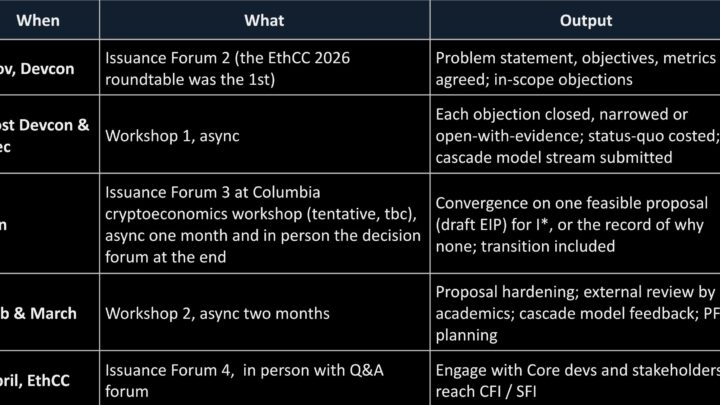
The proposal’s authors haven’t claimed consensus. CoinDesk notes there is no agreement yet among the validators and stakers whose returns the change would directly cut. The researchers themselves frame the roughly two-year phase-in (six months of prep followed by an 18-month ramp) as the trade-off for avoiding a more abrupt fix later.
Whether that trade lands in Hegotá or a subsequent fork remains open. Traders, as ever, disagree on which risk is bigger: uncapped staking growth, or a burn mechanism that Silagadze says could do more damage to DeFi than the problem it is meant to solve.