Ethereum’s path to its 2027 Hegotá upgrade is taking shape. The Ethereum Foundation’s Protocol cluster has published a unified tier list grading all 62 EIPs proposed for inclusion, with two proposals locked in as headliners and 28 declined outright.
The two must-ship picks split across the stack. On the consensus layer, FOCIL (EIP-7805) is the locked-in headliner, earning a unanimous S-tier at full participation. Forced inclusion lists would give any user a path to get an eligible transaction into a block without relying on centralized builders, making it structurally harder to censor specific transactions. FOCIL is expected to ship alongside EIP-8369.
On the execution layer, Frame Transactions (EIP-8141) takes the top slot, shipping with EIP-8250 and EIP-8272. The proposal brings native account abstraction on security grounds: a path to post-quantum signature schemes without requiring a fork for each scheme, aggregation so PQ verification can be priced, and a route to retiring secp256k1 keys. The cluster frames it as Ethereum’s quantum-readiness play.
Beyond the headliners, the tier list is thin at the top. Of the 62 proposals the cluster evaluated, 15 are expected to ship, 8 sit at B-tier with stated requirements, 7 are C-tier below the line, and 2 are TBD pending mainnet evidence, leaving 28 declined with stated reasons. Historically, major Ethereum upgrades have shipped with somewhere between 5 and 15 EIPs, so most current candidates will be deferred or dropped, as reporting on the ranking has noted.
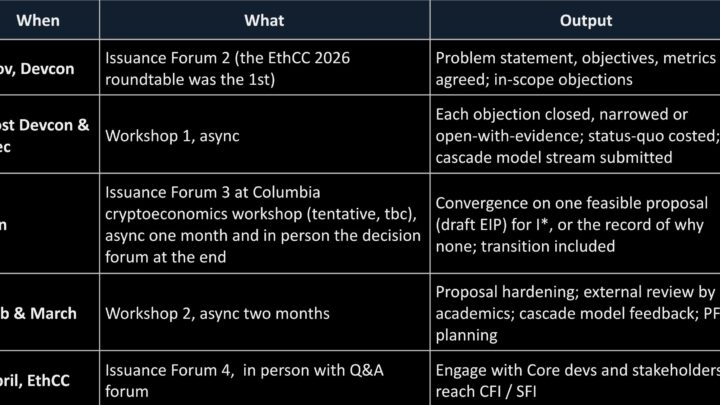
One rejection deserves a caveat: Tapered Issuance Burn (EIP-8363) drew a unanimous DFI, the lowest grade on the rubric, but the cluster was explicit that the grade is not a judgment on the proposal’s merits.
“Issuance policy touches every staker, every holder, and the network’s long-run security budget; at this stage, EF Protocol does not consider itself the right and sole body to give direction on it, and a fork scoping exercise is not the right venue to settle it,” the cluster wrote in the post.
The process behind the list was itself a first. The cluster of roughly 60 people across research and engineering had never published one unified view rather than per-team opinions. Sixteen contribution templates were filled out, twelve provided tier grades, and 397 individual grades landed across the 62 EIPs, an average of 6.4 per proposal with the most-discussed drawing 9. Six group calls and a 90-minute working session covered the contested items.
Nothing is final yet. Client teams have until September 10, 2026 to submit their own ranked preferences, which feed into the final selection, and Geth will still publish its own standalone list. The cluster is hosting a Reddit AMA on r/ethereum on September 16 at 2pm UTC to field questions on the list. No hard fork date has been set for Hegotá, which follows Glamsterdam (slated for Q4 2026), so the published tiers are a snapshot of priorities, not a locked scope.
The full list, visualized as a single chart, lives on Forkcast.